Lying Without Reason: The Surprising Psychological Reasons You Should Know
“I’m perfectly fine.”
“I’m busy, so I couldn’t come.”
“That was enough.”
Have you ever noticed that we tell little lies every day for no apparent reason? One of my clients, whom we may call “Zayd”, always told his wife half the price of a new shirt he bought. When I asked him why, his reply was: “I don’t know, doctor, just said so. There was no particular reason.”
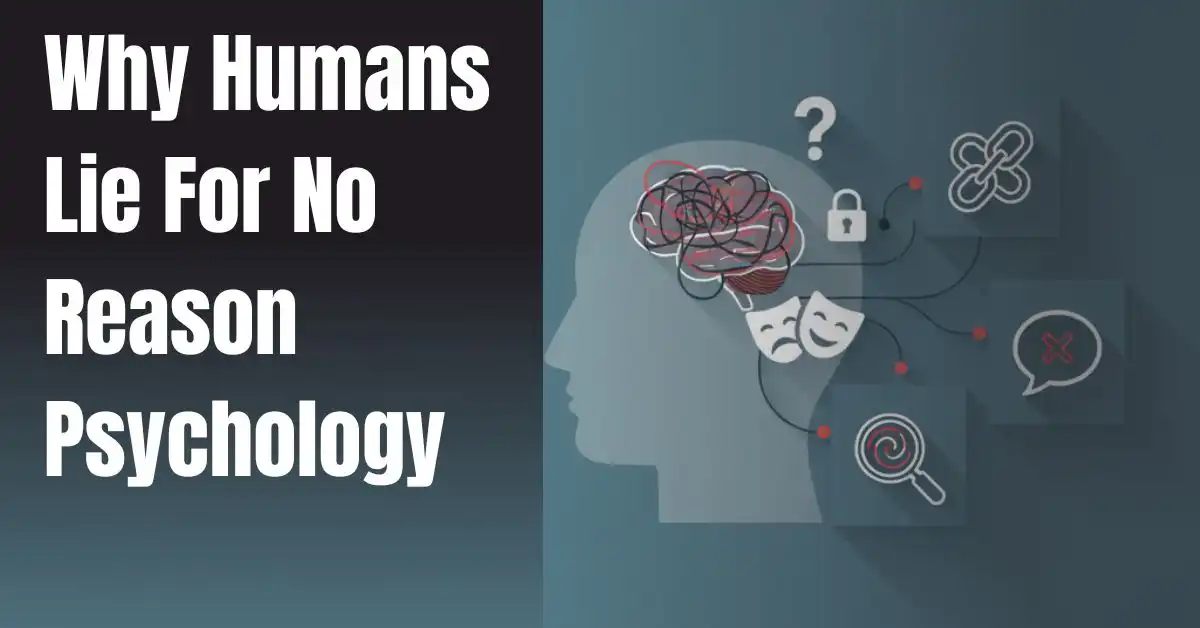
But science shows that there is always some psychological motivation behind Why Humans Lie For No Reason, even if we don’t see it. This article will explore their deeply buried motivations.
What is a lie? A psychological definition
Lying is not just hiding the truth. It is a complex mental process in which we deliberately create a false impression in the mind of another. It is a social strategy, sometimes a means of protection and sometimes of self-deception. According to a famous University of Massachusetts study, 60% of adults lie at least once in a 10-minute conversation. These data suggest that lying is a natural, albeit controversial, part of our social lives.
Why Humans Lie For No Reason Psychology: The 5 Basic Psychological Reasons
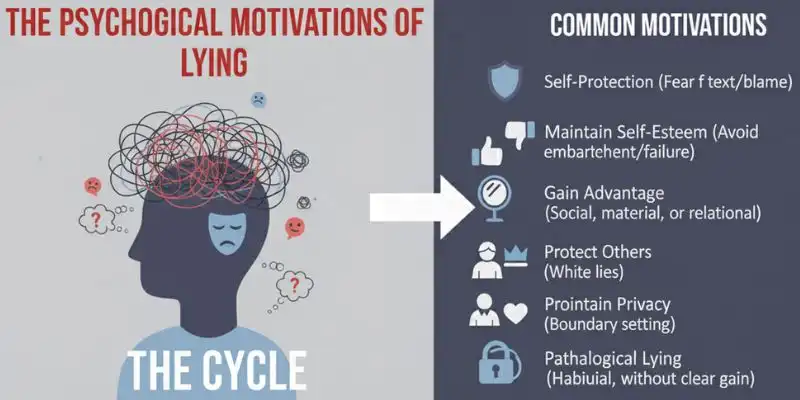
1. Self-Protection
Our brain wants to keep us emotionally and socially safe. A little lie can save us from criticism, disagreement, or a difficult explanation. It is a mechanism of our Social Survival. For example, if someone asks you why you’re not at work and you say, “Your message didn’t come” (even though it did), you’re actually avoiding potential conflict or resentment that might arise from your forgetfulness. It is our internal “fight or flight” system that lies to protect us from emotional danger.
2. Trying to keep Self-Esteem high
We often lie to present a better image of ourselves. Exaggerating our successes, making our past more interesting—these are all ways to hide our inner insecurities. One of my clients used to make up stories about his travels among his friends, just to make himself interesting and interesting. This lie is actually the fulfillment of a promise to yourself that “I am better than people think.” The age of social media serves to fuel this behavior, where we present a ‘curated’ and exaggerated version of our lives.
3. Keeping relationships smooth (Conflict Avoidance)
“Do you like my new hairstyle?”
“Yes, you look so beautiful!”
Does this phrase sound familiar? We often tell “white lies” to avoid hurting others’ feelings. This lie serves to hold our social fabric together. Psychologists call this ‘Prosocial Lying’, that is, lies that are told for the benefit of others or for social harmony. This lie makes us socially accepted and prevents rifts in relationships.
4. A sense of control and power (The Power Dynamic)
For some, controlling information is a source of power. When you tell someone what they want to know, or give them wrong information, you feel in control. This is a deeper aspect of Psychological Reasons For Lying. For example, an employee in an office may maintain his or her importance by withholding information about his or her work procedures. This attitude says “I am the door to this knowledge, and you can only access it through me.”
5. Habitual Lying
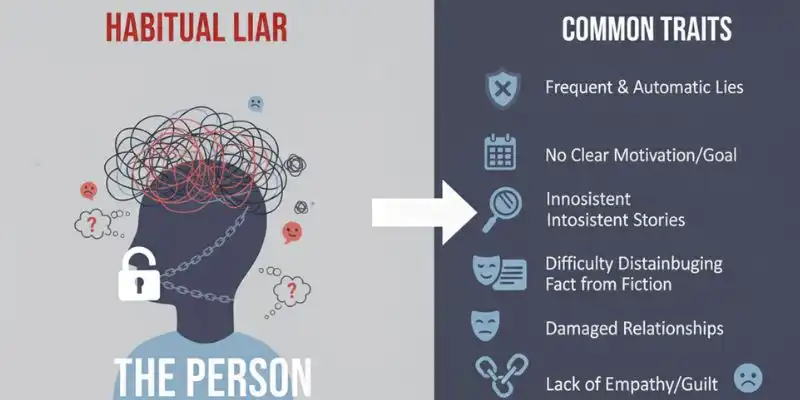
Just as any action becomes a habit through repetition, lying can also become an automatic response. For people with Constant Lying And Making Up Stories, it becomes an escape from reality. At first, lying is a deliberate decision, but over time it becomes so rich in the brain’s neural pathways that it feels easier than telling the truth. These people lie even on small things, because it has become their default mode of communication.
Why Do People Lie In Relationships? Why do lies thrive in relationships?
Relationships are the most fertile ground for lies. There are a few specific reasons why people lie in relationships:
- Maintaining independence: Telling your partner to “hang out with friends” while you’re at the cinema alone, just because you need a little personal space. This lie is told because of the fear that if you tell the truth, the other person will think that you don’t want to spend time with them.
- In the name of protecting the relationship: Hiding a meeting with a former relationship or friend so as not to raise unnecessary suspicions. The liar here believes he is avoiding a potential conflict, even though doing so destroys trust in the long run.
- “Saving” your partner: Hiding a financial problem or health problem so the other person doesn’t worry. Although the intention behind it is compassionate, this behavior undermines the principle of transparency in the relationship and exacerbates the problem rather than solving it.
- Shame or Guilt: Making a mistake that makes a person feel ashamed. In such a case, the person resorts to lying to hide the mistake.
One of my clients lied to her husband about missing her job for 6 months, just because she was afraid he would think she was a failure. She pretended to go to the office every day, until this lie took a serious toll on her mental health. This example shows how a lie can start as a small seed and grow into a major crisis.
10 Reasons Why People Lie: A Comprehensive List
- Emotional security: hiding your inner fears, insecurities and weaknesses from the world.
- Avoiding hurting other people’s feelings: White Lies are only intended to do this.
- Gaining Power and Control: Gaining superiority over others by monopolizing information.
- Seeking social acceptance: Changing one’s views, likes, or experiences to fit into a group.
- Self-Esteem Enhancement: Making yourself appear bigger and more important in the eyes of others (and in yourself).
- Conflict Avoidance: Lying to avoid any kind of conflict, argument or disagreement.
- Seeking personal gain: getting a job, buying cheap goods or avoiding punishment.
- Creating interest: Making up stories to make your life more exciting and mysterious.
- Maintaining privacy: Lying to prevent intrusion into something you want to keep private.
- Just as a habit: Without thinking, lying becomes an involuntary response.
Constant Lying And Making Up Stories:
This is a more serious form, called Pathological Lying or Mythomania. Such individuals find it difficult to differentiate between reality and the story they have created. Their lies often have no obvious benefit; It becomes a part of their personality.
What’s the difference? A normal liar lies for a purpose, whereas a pathological liar’s lies have no apparent ulterior motive. They lie because they can, and the world they make up feels better than the real world.
Brain chemistry: Some studies show that pathological liars have higher levels of white matter in the prefrontal cortex (the part of the brain responsible for moral decision-making, distinguishing between truth and falsehood) than normal people. This gives them the ability to fabricate very quick and complex lies, but it also affects their ability to control their own lies.
Is lying a disease?
According to DSM-5 (Diagnostic Manual of Mental Disorders), lying is not a separate disease in itself. However, it can be a symptom of other personality disorders such as Narcissistic Personality Disorder or Borderline Personality Disorder.
Lying in narcissism: Lies are resorted to in order to assert oneself, gain praise, and use others.
Lying in Antisocial Personality Disorder: It is common to lie to exploit, take advantage of, and hurt others.
Only a psychologist can diagnose whether lying is just a bad habit or a symptom of an underlying mental disorder.
My personal insight: The future of the psychology of lying
In my opinion, neuroscience will provide us with an even deeper understanding of lying in the coming years. fMRI scans may be able to show how “gratuitous” lying actually activates the brain’s reward centers. I believe that understanding lies is actually the key to understanding human relationships. To overcome the lies we have to understand our inner insecurities, fears and needs. We should try to create an environment, whether at home or in the office, where speaking the truth is not punished but understood.
Conclusion: A return to truth
A lie, no matter how “innocent” it may be, erects a wall between us and others. The biggest wall is the one we put up between ourselves and our true selves. The next time you find yourself lying for no apparent reason, take a breath and ask yourself: “Am I really trying to avoid something? Am I really afraid to admit this truth about myself?”
The truth can often be painful, but it is the foundation on which real, lasting and trusting relationships are built. Give yourself and others a chance for the truth.
Is it normal to tell small lies?
Yes, “white lies” are considered normal social behavior to keep social relations smooth. However, it becomes a problem when it becomes a habit, damages trust in relationships, or begins to affect your own integrity.
Which part of the brain is responsible for lying?
The prefrontal cortex, which controls our decision-making, planning and social behavior, plays a central role in the act of lying. Its activity increases when lying, as the brain has to perform the complex task of suppressing the truth, creating an alternative story, and presenting it.
What effect does parenting have on children’s lying?
If parents punish children severely for minor transgressions, the child may learn to lie out of fear of punishment. A forgiving, communicative and truth-encouraging environment fosters the habit of telling the truth in a child. Children learn from what they see, so if parents tell little lies themselves, children will also accept it as normal.
Can animals lie?
There is a kind of cunning in animals (like a bird giving a false alarm call to chase away other animals to get food), but it cannot be called “lying” in the human sense, because it does not involve higher mental abilities such as intentional deception and understanding the state of mind of others. These are just natural survival instincts.