Why Do People Like To Overthink? A Psychological Expedition
“Did I say that right?”
“Is he angry with me?”
“What if this decision goes wrong?”
If your mind is stuck in an endless loop of similar questions, then you are not alone. In my clinical experience as a therapist, I have observed that overthinking has become one of the most destructive mental habits of modern times. But the question arises: why do people overthink? Why do we find ourselves compelled to do this? Today we will go to the roots of this question, not just the superficial answer.
What Is Overthinking? Not Just Thinking, A Mental Prison
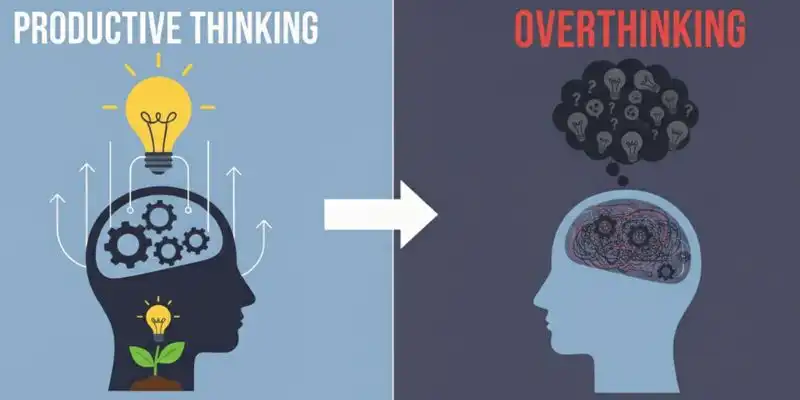
There is a difference between overthinking and productive thinking. Productive thinking gives you a solution to a problem, while Overthinking pushes you into a deep ditch from which it becomes difficult to get out. It’s a play inside your mind that has nothing to do with the real world.
One of my clients, Ahmed (name changed), told me that he spent the whole day thinking about an email response from his boss. They would repeatedly change words, flip sentences, and create imaginary scenarios about possible responses. The result? He was never able to send the email, and his performance was affected. This is the real tragedy of overthinking.
Why Do People Overthink Psychology: How does our mind become our enemy?
1. Ancient Minds, Modern World Challenges
Our brain is the result of millions of years of evolution. Its main function was to protect us from animals and natural calamities. The “lions” of our lives today are different: job pressures, economic problems, social relationships. Our brain is not designed to process these new threats, so it treats them as if they were a physical threat. Overthinking is actually our brain’s failed attempt to “solve” the threat.
2. The Illusion of Control
We live in an uncertain world. The human mind cannot tolerate uncertainty. Why Do People Overthink So Much? One of the main reasons is that when we think about a problem over and over again, we feel like we’re gaining “control” over it. It is an illusion, but this illusion gives us temporary comfort.
Why Do People Overthink In Relationships? When falling in love instead of melting
Relationships are the biggest testbed of emotional uncertainty. The answer to Why Do People Overthink In Relationships is hidden in our attachment styles.
The text message that was answered late: A secure person might think the other person is busy. An overthinker will immediately conclude, “He doesn’t love me,” “I said something wrong,” or “He’s leaving me.”
The role of social media: When you look at your partner’s status or check their followers, you’re fueling your brain. Every like, every comment and every follower can lead to a new thought.
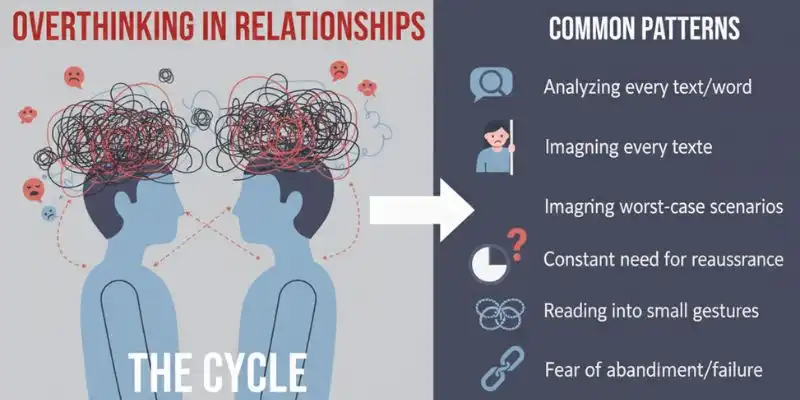
One of my friend, Sara, spent every night checking her boyfriend’s social media activity. She spends hours thinking about why she liked a certain girl’s photo. This thought was constantly damaging their original relationship.
Why Do People Overthink At Night? Why do the bells of the mind start ringing in the silence of the night?
Why is night time the most fertile ground for overthinking? Why Do People Overthink More At Night? The scientific reasons are:
Fatigue and poor alertness: At the end of the day, our mind is tired. Executive functions, which make logical decisions, are impaired. Conversely, the amygdala, the center of emotion, becomes more active. The result: an emotional, illogical thought storm.
Elimination of external distractions: During the day, our brain processes many external stimuli (tasks, people, sounds). At night, when all this is over, the mind turns to its internal thoughts.
Avoiding Sleep: For some people, overthinking becomes a way to avoid going to bed, especially if they are unable to sleep or have bad dreams.
Is Overthinking a Sign of Intelligence? Is Overthinking A Sign Of Intelligence?
This is a huge and dangerous fallacy. Yes, intelligent people can see complex patterns, make connections, and think from different perspectives. But overthinking is not intelligence, but the misuse of intelligence.
Real intelligence is about coming up with solutions, while overthinking is about turning problems around. An intelligent person thinks and then acts. An overthinker keeps thinking and is unable to act. This is Analysis Paralysis.
Overthinking Effects On Body: The Destructive Effects You Never Thought About
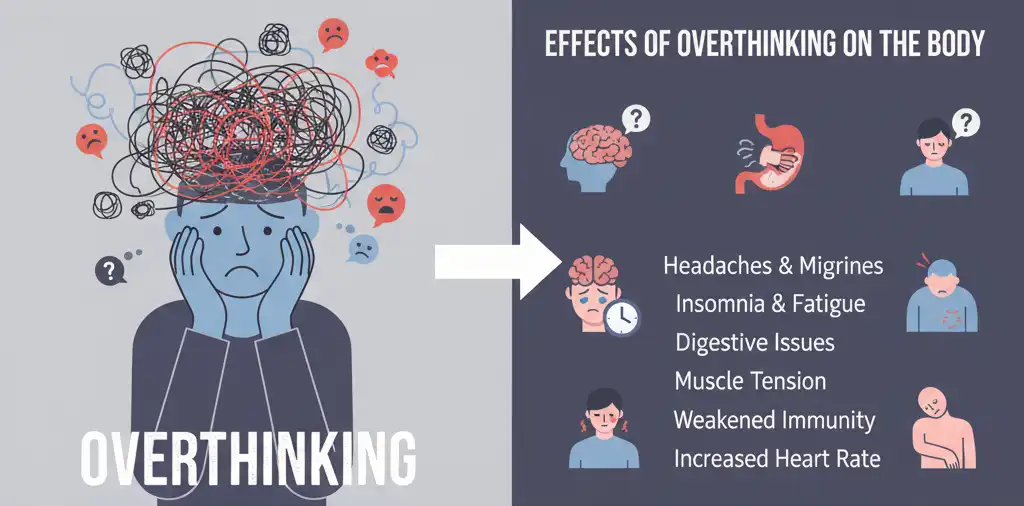
Overthinking is not limited to your mind. It’s a real, physical assault on your entire body.
Circulatory system: Chronic stress hormones (cortisol) increase blood pressure and heart rate, increasing the risk of heart disease.
Immunity: Chronic stress weakens your immune system, making you more susceptible to diseases.
Digestive system: Headaches, muscle tension, and digestive problems (such as irritable bowel syndrome) are common physical manifestations of overthinking.
Overthinking Symptoms: How to Recognize If You’re Just Thinking or Overthinking?
Some clear signs of overthinking are:
- Repeating the same idea over and over again.
- Getting upset over small things.
- Feeling extremely difficult to decide.
- Keep asking “what if” questions about past events.
- Finding hidden meanings in people’s words and actions.
- Experiencing physical discomfort and sleep disturbances.
My Personal Insight: The Way Out of Overthinking
In my opinion, overthinking will be recognized as a separate and serious disorder in the field of mental health in the coming years. In my experience, the most effective treatment for overthinking is mindfulness practice.
- Mindfulness: It teaches you to observe your thoughts without judgment, not to get caught up in them. This is the ability to create a distance between your thoughts and yourself.
- Time-limited thinking: Say to yourself, “I’m going to think about this problem for just 20 minutes this evening.” At the end of that time, you must take action.
- Focus on the solution, not the problem: Ask yourself, “Is there a practical solution to this thought? If so, what is it? If not, it’s best to let it go.”
Conclusion: Take Control Of The Power Of Thought
Thinking is a gift, Overthinking is a curse. The only difference is: control. Either you control your thoughts, or they control you. The next time your mind starts to overthink, ask it: “Is this thinking leading me to a solution, or just wandering around a dark house?” The answer will often show you the way.
What is the difference between Overthinking and Anxiety?
Overthinking is often a symptom of anxiety. Anxiety is a broader emotional state that includes worry and fear, while Overthinking is the mental manifestation of this state.
Is Overthinking a Mental Illness?
Overthinking is not an official mental illness in itself, but it is a very common symptom of Generalized Anxiety Disorder (GAD), depression, and other conditions.
What to do for quick relief from overthinking?
Focus on your breath and inhale for 5 seconds, hold for 5 seconds, and exhale for 5 seconds.
See 5 things around you, hear 4 sounds, touch 3 things, smell 2 smells, and feel 1 taste. It will bring you back to the present moment.
Which Prefrontal Cortex and Amygdala are Involved in Overthinking?
The Prefrontal Cortex (the frontal lobe of the brain) is the center of logic and decision-making. The Amygdala is the center of our emotions and fears. During overthinking, the Amygdala becomes overactive and suppresses the functions of the Prefrontal Cortex, causing us to become irrational and emotional.